Sustainable medical device manufacturing represents the future of healthcare production for companies aiming to balance profit with environmental preservation. Modern MedTech leaders no longer view sustainability as a luxury or a side project; they recognize it as a core operational necessity.
By shifting production closer to the end market, companies achieve remarkable efficiency. This article explores how nearshoring in Mexico empowers brands to meet aggressive ESG targets while maintaining high quality and competitive costs.
Reducing Carbon Footprint through Short-Haul Logistics
Logistics often define the environmental cost of a product before it even reaches a hospital shelf. Traditional trans-Pacific shipping relies on massive container ships that burn heavy bunker fuel, emitting enormous amounts of sulfur and CO2 during their weeks-long journey across the ocean.
When you manufacture in Asia, your carbon footprint reduction efforts face an immediate uphill battle. The sheer distance creates a massive ecological debt that companies struggle to offset. In contrast, Rexmed leverages Mexico’s strategic proximity to the United States to turn logistics into a real advantage.
We slash transit times from months to a few weeks by trucking devices across the border. Our proximity empowers you to ship smaller loads more often, cutting out the need for massive warehouses and the high carbon cost of stagnant inventory. We replace supply chain bloat with a lean, responsive, and eco-friendly flow.
Nearshoring promotes sustainable medical device manufacturing by eliminating carbon-heavy air freight often required to solve distant supply chain delays. Shorter routes slash emissions and grant your team better control, ensuring life-saving technology arrives with a much smaller environmental impact.
Implementing Green Manufacturing Standards in MedTech
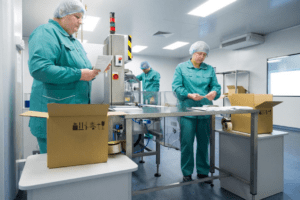
At RexMed, we integrate green manufacturing principles directly into our daily operations to drive innovation and environmental excellence. We do this because we understand that Original Equipment Manufacturers (OEMs) face increasing pressure to prove their environmental stewardship through tangible actions.
Consequently, we build our processes around resource efficiency and technical precision. Moreover, our facilities use high-efficiency HVAC and smart LED lighting to curb energy demand during sensitive production stages.
We drive your production toward a smaller footprint by mastering these four operational pillars:
● Energy optimization. We optimize every second of machine time to prevent energy waste. By synchronizing our cycles, we drive down total electricity consumption without ever slowing down your line.
● Waste diversion. We reclaim specialized materials through rigorous recycling protocols. By diverting waste from landfills, we actively build a circular economy that respects the planet as much as your product.
● Resource tracking. We fuel your ESG strategy with real-time data on resource consumption. This transparency ensures your project meets the highest standards of internal accountability and reporting.
● Material integrity. Every component meets strict FDA safety standards while simultaneously adhering to our internal eco-friendly manufacturing protocols to ensure high-quality results.
By managing materials responsibly, we maintain clean production without compromising quality. We set high conservation standards to streamline your path to sustainability. We eliminate the guesswork, ensuring your project leaves the smallest possible mark on the planet.
Why a Sustainable Medical Device Manufacturing Strategy Wins Investors
Private equity firms now look far beyond simple profit margins by prioritizing Environmental, Social, and Governance (ESG) metrics when valuing MedTech companies. A robust, sustainable medical device manufacturing strategy signals long-term viability and risk mitigation to these stakeholders.
Companies that ignore these trends often face higher capital costs and potential divestment from major institutional players. Investors recognize that sustainable practices correlate with operational excellence and future-proofing against resource scarcity.
Today’s financial climate demands hard data and verified results rather than verbal promises. To win over sophisticated investors, companies must demonstrate excellence in the following critical areas.
Regulatory compliance and SEC readiness
The regulatory landscape in the United States is shifting rapidly toward mandatory disclosures that demand absolute operational transparency. The SEC and global bodies now require companies to report on the environmental impact of their entire sustainable supply chain to ensure full accountability.
Nearshoring provides the visibility for these rigorous audits, making it easier to verify compliance in Mexico than in distant overseas locations. By manufacturing closer to Distribution Centers , you gain direct access to production data and facility inspections, which simplifies the task of meeting international reporting standards.
If you would like to learn more about global standards for environmental management, visit the International Organization for Standardization (ISO). Discover how these benchmarks strengthen your operational strategy.
Risk mitigation and supply chain resilience
Climate change and geopolitical instability threaten global trade routes, but nearshoring reduces reliance on fragile trans-Pacific corridors. Investors favor this model because it minimizes the risk of costly disruptions and protects the company’s ability to fulfill orders during global crises.
Conscious healthcare systems
Sustainable medical device manufacturing protects your brand reputation in an increasingly conscious market where clinical excellence alone no longer guarantees success. Modern healthcare systems now include strict “green” requirements in their procurement contracts and vendor evaluations.
They prefer partners who share their commitment to a healthier planet, directly impacting your top-line growth and market share. This strategic differentiation allows your brand to stand out in a crowded marketplace, fostering deep loyalty among providers who prioritize ethical sourcing.
Operational cost savings of sustainable medical device manufacturing
Beyond the ethical benefits, green manufacturing reduces waste and energy consumption. Lower utility bills and reduced material waste translate directly into improved EBITDA. Investors appreciate management teams that find the intersection between environmental stewardship and financial efficiency.
By adopting these practices now, you secure your position as a preferred vendor in the global MedTech ecosystem. This strategic alignment turns environmental responsibility into a powerful engine for financial growth and market stability.
Transitioning to a sustainable model no longer represents a simple operational cost. Instead, it represents a high-yield investment that secures the long-term profitability and competitive resilience of your entire company.
RexMed: your strategic ally in clean manufacturing
We believe that high-quality medical devices and environmental care go hand in hand. Our location, manufacturing technology, and corporate social responsibility support the transition to a circular economy. We invite you to explore how our facilities transform your production goals into sustainable achievements.
Partnering with RexMed grants you more than a manufacturer; you gain a strategic ally that prioritizes sustainable medical device manufacturing. We help you navigate complex MedTech hurdles while hitting your ESG targets with precision. Together, we craft a legacy that protects both the patient and the planet.