Finding a binational manufacturer is a strategic decision in the medical device industry. And while regulatory compliance is essential, the most forward-thinking companies understand that the factors that truly define a strong partner extend beyond this.
This article examines the five key criteria that companies must consider when selecting a partner. However, it’s not just about compliance; the partner must also present sustainable competitive advantages, reduce risks, and maximize return on investment.
Binational Manufacturer: Dual Regulatory Expertise
Dual regulatory experience is a fundamental pillar when selecting a reliable binational manufacturer. A manufacturer with proven competence in both the FDA and COFEPRIS regulations has a structural understanding that goes beyond simply obtaining certifications.
The FDA (U.S.) and COFEPRIS (Mexico) may share comparable device classifications, but approval procedures can vary significantly. Therefore, it is vital that an experienced manufacturer recognizes these differences and develops a unified registration strategy.
Similarly, the producer’s experience with modernized regulations influences the selection of OEM partners—for example, the new COFEPRIS updates for 2025, which accelerate the agreement of research protocols.
The constant association between the FDA and COFEPRIS emphasizes the alignment of regulatory frameworks through the IMDRF and the MDSAP. A manufacturer with dual knowledge can get ahead and adjust to these variations, safeguarding the long-term viability of its supply chain.
Cross-Border Logistics
Geographical proximity offers initial benefits, but actual efficiency relies on optimized cross-border logistics integration and customs expertise. Below, you will find the characteristics that the ideal partner for binational cooperation should have:
- Customs optimization and compliance with USMCA. Manufacturers should demonstrate expertise in USMCA (United States-Mexico-Canada Agreement) protocols, ensuring preferential tariff treatment through the proper handling of Certificates of Origin.
- Storage and distribution strategies. The device supplier Mexico-US must have real binational logistics through a smart warehousing policy. Cross-border warehousing solutions allow agile order fulfillment and diminish delivery times.
- Supply chain risk mitigation. A producer with established binational logistics procedures can answer more quickly to troubles. This operational flexibility guarantees business permanence in a way that other supply chains cannot match.
Geographic closeness gives a primary advantage, but actual efficiency stems from enhanced logistics integration and customs expertise. To certify long-term success, select a partner with proven experience in USMCA compliance and binational storage strategies.
Cleanroom and Assembly Capabilities
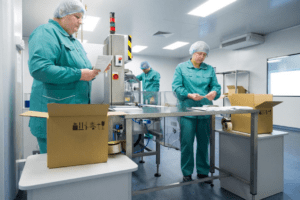
The manufacturing environment requires cleanroom management procedures that meets specific requirements and validated assembly processes. Thus, when selecting between an ISO 7 and ISO 8 cleanroom, consider the particular requirements of the product and the general process.
On the one hand, ISO 8 allows up to 3,520,000 particles ≥0.5µm per cubic meter, with 5-48 air changes per hour. This makes it suitable for packaging, food processing, and some lower-risk medical module assembly phases.
On the other hand, ISO 7 only allows 352,000 particles ≥0.5µm per cubic meter, requiring between 30 and 60 air changes per hour. It is common in the manufacture of invasive medical devices, biotechnology, and IV compounding.
In addition, a crucial aspect of cleanroom design is differential pressure management, which warrants that air always flows from the cleanest areas to the least controlled ones. In sectors such as pharmaceuticals and microelectronics, these measures guarantee product quality and procedure safety.
Validated Design and Airflow
Cleanroom classification involves more than HVAC specifications; it is also a design requirement. Effective cleanroom layouts often include vestibules or airlocks to prevent particle migration from less clean areas.
For example, accessing an ISO 7 cleanroom ideally involves passing through an ISO 8 antechamber. Engineers validate airflow patterns—whether non-unidirectional (ISO 7/8) or unidirectional (ISO 5/6)—to preserve environmental control.
Assembly Processes and Quality Control in Binational Manufacturer
Beyond the cleanroom itself, it is vital to evaluate the manufacturer’s validated assembly processes and quality controls. This comprises documented procedures for each phase of production, testing, and inspection.
The presence of skilled clusters is an excellent indicator of the accessibility of professional talent and providers qualified to operate in these controlled environments.
Such clusters provide access to skilled workers and promote teamwork among manufacturers, providers, and regulatory bodies. This network accelerates innovation, ensures compliance with international standards, and enhances supply chain resilience.
In certain regions, the concentration of expertise creates a competitive advantage, allowing companies to streamline production while keeping strict contamination controls. Ultimately, assessing both aspects offers a more complete view of quality assurance and operational reliability.

Scalability Across Markets
An ideal binational partner must prove the ability to scale production volumes and adapt to the needs of both markets. The most salient characteristics of a reliable binational manufacturer in this regard are the following:
- Access to the growing Mexican domestic market. Mexico represents a market opportunity. A manufacturer with experience and COFEPRIS licenses to market in the local market can be your gateway to capturing a share of this value.
- Flexibility for high-growth segments. Production capacity must be flexible to adapt to high-growth device segments. A partner that can pivot resources or has knowledge in these specific areas offers a significant competitive advantage.
- Resilience of the regional supply chain. Scalability also refers to resilience. Having a manufacturing partner with access to well-developed clusters provides strategic options for expanding or relocating operations.
A strong binational partner should combine access to the Mexican market, flexibility for growing segments, and a resilient supply chain. These characteristics are crucial for scaling production and meeting the needs of both markets competitively.
Traceability and Audit Readiness
In an industry where patient safety is paramount, complete traceability and continuous planning for audits mean a culture of quality that is deeply rooted. It is significant to highlight the ISO 13485 standard, which determines clear requisites for identification and traceability.
In this case, manufacturers must have recorded actions for classifying products and keeping complete records. This is vital for the efficient management of recalls, should they be necessary.
Another feature is the application of a Unique Device Identification (UDI) system. The manufacturer’s capacity to handle a customer or regulatory audit at any time, with minimal notice, is also something to contemplate.
Therefore, selecting a binational medical device manufacturer is a multifaceted strategic decision. Moreover, it must go beyond basic regulatory obedience to consider criteria such as dual regulatory experience and cross-border compliance.
If you need more information about our services and solutions for the design and manufacturing of medical devices in a binational environment, contact us!